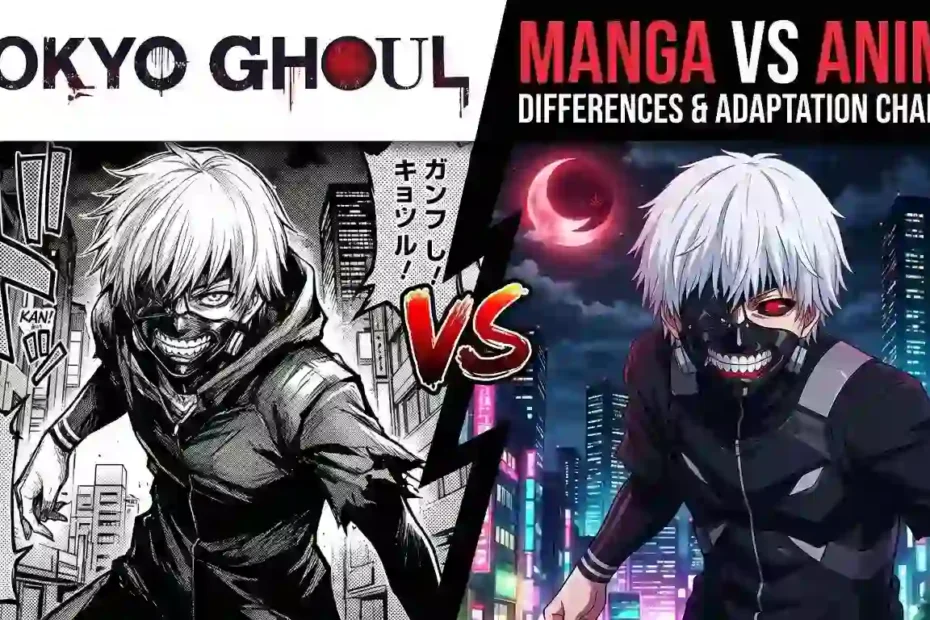
Fans who watch the Tokyo Ghoul anime first often feel confused when they pick up the manga. The anime rearranges major story beats, removes entire arcs, and changes character motivations in ways that shift the story’s emotional core. This guide breaks down every critical divergence so you can decide which version deserves your time.
Why the Tokyo Ghoul Anime Divides the Fandom
Studio Pierrot adapted Sui Ishida’s dark fantasy during its peak serialization. The production committee pushed for a twelve-episode first season, forcing massive compression. Root A, the anime-original second season, diverged entirely from the source material. Many viewers who started with the show never realized they missed half the story. The manga spans 179 chapters across fourteen volumes. The anime covers roughly sixty chapters before veering into original territory. That gap represents thousands of panels of character development, world-building, and thematic nuance that never reached the screen.
Kaneki’s Transformation Differs Fundamentally
In the manga, Ken Kaneki’s evolution from timid student to one-eyed ghoul unfolds across dozens of chapters. His torture at Jason’s hands spans multiple episodes in the anime but receives far more psychological depth on the page. The manga shows his internal monologue during every breaking point. Readers witness his personality fracture and reconstruct in real time. The anime condenses this into a few dramatic scenes, losing the gradual horror of his identity crisis. White hair appears in both versions, but the manga earns it through sustained suffering rather than a single traumatic night.
The Aogiri Tree Arc Exists Only in the Manga
One of the largest Tokyo Ghoul manga vs anime differences centers on the Aogiri Tree invasion. The manga devotes an entire arc to Kaneki joining the terrorist organization after his rescue. He forms bonds with Ayato, Hinami, and Banjou. He learns ghoul politics from the inside. The anime skips this entirely. Kaneki never joins Aogiri in Root A. Instead, he wanders alone, creating a loneliness the manga never explores. This omission removes critical context for his later actions and relationships. Anime-only viewers miss why Kaneki trusts certain characters or understands ghoul society’s fractures.
Tokyo Ghoul √A Creates an Alternate Timeline
Root A functions as a what-if scenario rather than an adaptation. Ishida provided rough plot points but did not write the scripts. The anime kills Hideyoshi Nagachika in episode twelve. The manga keeps him alive, revealed later as Scarecrow. Anteiku burns in both versions, but the circumstances differ wildly. Kaneki carries Hide’s body from the ruins in the anime. In the manga, Kaneki fights Arima alone while Hide survives elsewhere. These changes cascade through every subsequent character arc. Touka’s development, Nishiki’s role, and the CCG’s strategy all shift because the foundation changed.
Hide’s Fate Changes the Entire Emotional Core
Hide represents Kaneki’s tether to humanity. The manga preserves this thread across both Tokyo Ghoul and Tokyo Ghoul:re. Their reunion in the sewers during the Dragon arc delivers one of the series’ most powerful moments. The anime severs this thread early. Hide’s death in √A removes Kaneki’s strongest motivation for restraint. Without Hide, Kaneki’s descent into the Dragon form lacks the same tragic weight. The manga’s Hide operates in shadows, gathering intelligence, protecting allies, and ultimately saving Kaneki from himself. Anime viewers never witness this quiet heroism.
Touka Kirishima Receives Different Treatment
The manga develops Touka alongside Kaneki. Her coffee shop management, university struggles, and ghoul identity crisis receive equal panel time. She opens :re cafe as a sanctuary. She wrestles with pregnancy and motherhood in :re. The anime relegates her to love interest and occasional fighter. Her character song episodes in Root A feel like compensation for reduced agency. Manga readers see Touka lead, decide, and endure. Anime viewers see her wait and worry. This disparity exemplifies how adaptation choices reshape female characters in shonen/seinen translations.
The CCG Investigators Lose Depth in Animation
Kishou Arima appears as a near-mythical figure in both versions. The manga reveals his half-ghoul biology, his garden of failed experiments, and his suicide mission decades in the making. The anime hints at his strength but never explains his origins. Juuzou Suzuya’s trauma, his relationship with Shinohara, and his growth from weapon to person unfold across manga chapters. The anime shows his combat prowess but skips his humanity. Akira Mado’s grief, her investigation into her father’s death, and her eventual alliance with ghouls disappear entirely. The CCG becomes a faceless antagonist force rather than a collection of broken people.
Rize Kamishiro’s Role Expands Beyond the Prologue
The manga treats Rize as a continuous presence. Her kakuhou influences Kaneki’s biology. Her consciousness merges with Dragon. Her past with V organization and the Washuu clan drives late-series revelations. The anime uses her as an inciting incident only. She appears in flashbacks and hallucinations but never as an active force. The manga’s Rize orchestrates events from within Kaneki’s mind. Her relationship with Shachi, her escape from V, and her true nature as a Washuu pawn remain anime mysteries. This reduction flattens the series’ central conspiracy.
Anteiku’s Destruction Plays Out Differently
Both versions destroy the coffee shop. The manga’s Owl Suppression Operation spans dozens of chapters. Multiple perspectives intertwine: Amon versus Kaneki, Shinohara versus the Owl, the manager’s final stand. The anime compresses this into two episodes. The manager’s kakuja form, his backstory as the One-Eyed Owl, and his sacrifice receive minutes instead of chapters. Tsukiyama’s desperate defense of Kaneki, Nishiki’s protection of Kimi, and Yomo’s confrontation with Uta all vanish. The manga makes Anteiku’s fall feel like a war. The anime makes it feel like a skirmish.
Ghoul Biology and RC Cells Receive Scientific Treatment
Ishida built a pseudo-scientific framework for ghoul physiology. RC cells, kakuhou types, kagune shapes, and quinque steel manufacturing receive detailed explanation. The manga includes diagrams, CCG reports, and character lectures. The anime mentions RC levels occasionally but never systematizes them. Viewers never learn why rinkaku regenerates faster or why ukaku exhausts quickly. The manga’s battles become tactical puzzles. The anime’s battles become visual spectacles. This difference matters for readers who want to understand power scaling rather than just watch fights.
The Clowns and Pierrot Organization Operate in Shadows
The manga introduces the Clowns early through Uta, Itori, and Nico. Their manipulation spans the entire story. They orchestrate the Steel Beam incident. They infiltrate every faction. Their leader, Roma Hoito, hides in plain sight as a waitress. The anime includes Uta and Itori but never names their organization or reveals their scope. The Pierrot reveal in :re recontextualizes every prior “coincidence.” Anime viewers miss this layer entirely. The Clowns transform Tokyo Ghoul from a conflict between species into a puppet show directed by immortals.
V Organization and the Washuu Clan Drive the True Plot
The manga’s final antagonist isn’t Aogiri or CCG. It’s V, the shadow organization maintaining the human-ghoul balance through controlled conflict. The Washuu clan, CCG’s founders, are ghouls farming their own kind. Furuta Nimura’s rise, his clown persona, and his plan to destroy the system require hundreds of chapters to unfold. The anime never mentions V. The Washuu appear briefly as CCG leadership. Furuta becomes a minor villain rather than the architect of tragedy. Without V, the series loses its critique of institutional corruption and cyclical violence.
Dragon Arc Exists Only in the Manga
The Dragon arc represents Tokyo Ghoul’s true climax. Kaneki’s kakuja mutates into a city-consuming monstrosity. Tokyo’s population faces ghoulification through airborne RC cells. The CCG collapses. Former enemies unite. Hide reveals his survival. Touka gives birth amid ruin. The manga spends thirty chapters resolving every thread. The anime ends with Kaneki carrying Hide’s corpse. No Dragon. No cure. No reconciliation. Anime-only viewers never reach the story’s thematic conclusion about coexistence, sacrifice, and the possibility of breaking cycles.
Character Deaths Carry Different Weight
The manga kills characters deliberately. Shirazu dies protecting his squad. Hairu dies investigating Rushima. Arima dies by his own design. Each death advances theme and plot. The anime kills for shock. Hide dies to motivate Kaneki. Arima dies because the plot requires it. The emotional resonance differs because the buildup differs. Manga readers mourn characters they’ve known for hundreds of chapters. Anime viewers mourn characters they’ve known for episodes. This disparity affects how each audience remembers the series.
Tokyo Ghoul:re Manga Continues Where the Anime Cannot
:re spans 179 additional chapters. It follows Haise Sasaki, Kaneki’s amnesiac CCG persona. It explores the Quinx Squad, half-human investigators with implanted kakuhou. It resolves every dangling thread from the original series. The anime’s :re adaptation attempts to condense this into twenty-four episodes. It rushes the Cochlea raid, the Rushima landing operation, the Clown siege, and the Dragon emergence. Critical characters like Mutsuki, Urie, and Saiko receive surface-level treatment. The manga’s :re is a psychological thriller about identity, memory, and institutional rot. The anime’s :re is a highlight reel.
Power Scaling Follows Internal Logic in the Manga
Ishida establishes rules then follows them. Kagune types counter each other in rock-paper-scissors fashion. RC cell count determines regeneration speed and kakuja potential. Half-humans age rapidly but possess superior physical specs. The anime ignores these rules when convenient. Kaneki defeats opponents he should lose to because the episode needs a climax. Arima’s combat speed varies by scene. The manga’s consistency allows readers to predict and analyze battles. The anime’s inconsistency forces viewers to accept dramatic fiat.
Themes of Identity and Otherness Deepen on the Page
The manga’s central metaphor—ghouls as marginalized peoples—receives nuanced exploration. Ghouls eat humans to survive, creating unavoidable moral complexity. The CCG protects humans by exterminating sentient beings. Both sides commit atrocities. Both sides contain individuals seeking peace. The anime simplifies this into monsters versus hunters with a few good apples. The manga forces readers to sit with discomfort. Kaneki’s final solution—becoming the Dragon to unite both species through shared trauma—emerges from this complexity. The anime’s ending lacks the philosophical foundation for such a resolution.
Art Style Evolution Reflects Narrative Maturity
Ishida’s art transforms across fourteen volumes. Early chapters feature rough lines, heavy screentones, and experimental layouts. Later chapters display refined anatomy, atmospheric shading, and cinematic composition. This visual evolution mirrors Kaneki’s psychological journey. The anime’s art direction remains relatively static. Character designs simplify for animation. The manga’s iconic spreads—Kaneki’s centipede kakuja, the Dragon towering over Tokyo, the final sunrise over :re cafe—exist as static images that readers absorb at their own pace. Animation cannot replicate the contemplation a reader gives a double-page spread.
Reading Order Recommendations for Newcomers
Start with the original Tokyo Ghoul manga, all 179 chapters. Skip the anime entirely if you want the complete story. If you’ve watched the anime, begin the manga from chapter one—do not assume you know the plot. The divergence starts immediately. Read Tokyo Ghoul:re immediately after finishing the original. The two series function as one continuous narrative. Avoid the Jack and Pinto OVAs until after :re; they provide backstory for Arima and Tsukiyama but assume manga knowledge. The light novels fill gaps but aren’t essential.
Comparison Table: Manga vs Anime at a Glance
| Element | Manga | Anime |
|---|---|---|
| Total Chapters/Episodes | 179 chapters + 179 :re chapters | 12 + 12 + 24 episodes |
| Aogiri Tree Arc | Full arc, Kaneki joins | Skipped entirely |
| Root A / Season 2 | Does not exist | Anime-original storyline |
| Hide’s Fate | Alive, operates as Scarecrow | Dies in Kaneki’s arms |
| Arima’s Backstory | Fully revealed (half-ghoul, V, garden) | Hinted, never explained |
| V Organization | Central antagonist | Never mentioned |
| Clowns/Pierrot | Major manipulators throughout | Background characters only |
| Dragon Arc | 30-chapter climax | Does not exist |
| Touka’s Agency | Leads :re cafe, makes decisions | Reduced to support role |
| Ghoul Biology | Detailed system (RC cells, kagune types) | Mentioned rarely |
| Quinx Squad | Central to :re | Rushed introduction |
| Furuta Nimura | Mastermind antagonist | Minor villain |
| Ending | Thematic resolution, coexistence | Ambiguous, Kaneki carries Hide |
| Pacing | Deliberate, psychological | Compressed, action-focused |
| Thematic Depth | Identity, cycles, institutional corruption | Survival, tragedy, friendship |
Frequently Asked Questions
Is the Tokyo Ghoul anime canon to the manga?
No. The first season adapts roughly sixty chapters with significant changes. Root A (season two) is an anime-original story that contradicts the manga. :re anime attempts to adapt the sequel but assumes Root A events.
Should I watch the anime before reading the manga?
Reading the manga first provides the complete, intended story. Watching the anime after helps you appreciate adaptation choices. Watching first creates confusion because major plot points differ.
How many chapters does the anime cover?
Season one covers approximately chapters 1-60 with heavy condensation. Root A covers no manga chapters—it’s original. :re anime condenses 179 chapters into 24 episodes.
Why does Hide die in the anime but live in the manga?
Root A’s writers chose Hide’s death for dramatic impact. Ishida’s manga uses Hide’s survival as a long-term narrative thread culminating in the Dragon arc reunion.
What is the correct reading order for Tokyo Ghoul?
Tokyo Ghoul (179 chapters) → Tokyo Ghoul:re (179 chapters). Optional: Jack and Pinto OVAs after :re. Light novels anytime after original series.
Does the manga have a better ending?
The manga’s ending resolves every major thread thematically and narratively. The anime ends mid-story with Kaneki walking through snow carrying a corpse. Most fans consider the manga ending superior.
Final Thoughts: Choose the Complete Story
The Tokyo Ghoul manga vs anime differences aren’t minor adaptations. They represent two different stories sharing a premise. The manga delivers a fifteen-year narrative about identity, systemic corruption, and the possibility of breaking generational cycles of violence. The anime delivers a stylish, truncated tragedy that discards the machinery driving that narrative. If you value character psychology, thematic coherence, and earned endings, read the manga. If you prefer animation spectacle and can accept an incomplete story, the anime exists as a distinct experience. But know this: the anime shows you the shadow. The manga shows you the object casting it. Only one lets you hold the whole shape in your hands.