Raimei to Zansetsu: The Complete Guide to Story, Meaning and Where to Read
 By Mariam Nazir
10 min read
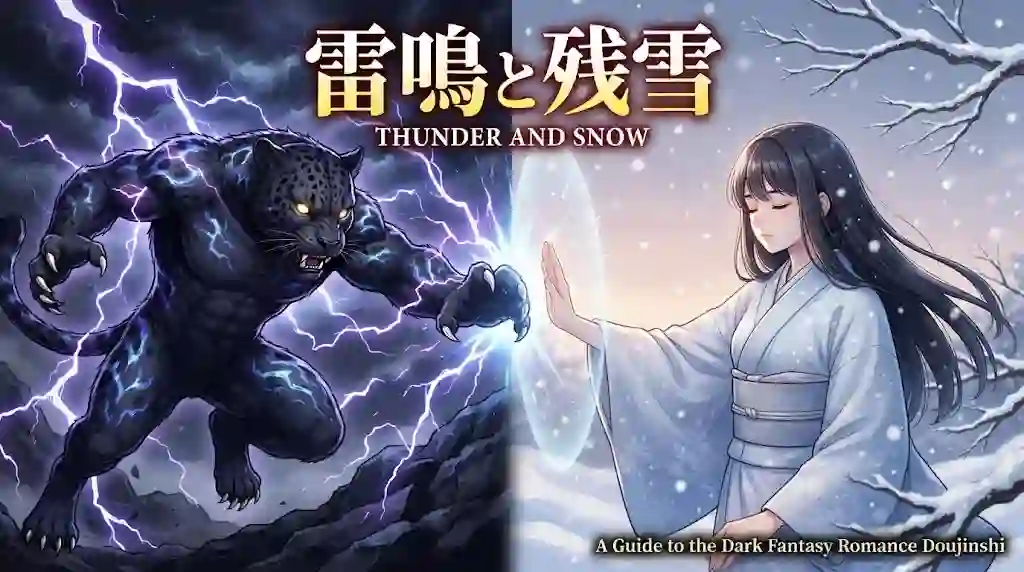
Searching for information on Raimei to Zansetsu often leads to forum threads, bare database listings, and pirated files that tell you very little. This guide gives you a clear picture of the work. You will learn what it is, who made it, what the title means, what happens in the story, why it has drawn such a devoted readership, and how to read it legally. Because this is an adult title, the guide also covers the content warnings you need before you buy.
What Is Raimei to Zansetsu?
Raimei to Zansetsu is a complete 2023 Japanese oneshot doujinshi, a fan-circle or independent comic, written and drawn by Jinmen Shijimi under the circle name Negi Manju. It runs about 100 pages and is sold digitally through DLsite. The English edition is titled Thunder and Snow, and it is an 18+ work with explicit adult content.
Because it is a oneshot, the story has a beginning, a middle, and an ending within a single volume. You do not need to track a long run of chapters or wait for new releases. Many readers appreciate that compact structure, since it lets the emotional arc land in one sitting.
The Japanese Title and Its Meaning
The Japanese title, 雷鳴と残雪, combines two words that carry strong natural imagery. Raimei (雷鳴) means thunderclap or the rumble of thunder, while zansetsu (残雪) means snow that lingers after spring has arrived. Put together, the phrase describes a sudden, violent force meeting something quiet and stubborn that refuses to melt.
That image maps directly onto the two leads. The thunder represents a force that announces itself and cannot be ignored. The lingering snow represents something that stays in the shade long after the season should have changed. Readers who know Japanese poetry will recognize how much meaning the title packs into four characters.
How the Title Translates
Translators have rendered the title in several languages, and each version adjusts the emphasis slightly. The most popular variations are contrasted in the table below.
| Language | Title | Literal Sense | What It Emphasizes |
|---|---|---|---|
| Japanese | 雷鳴と残雪 | Thunder and lingering snow | The contrast between a sudden force and a stubborn, lingering calm |
| English | Thunder and Snow | Storm and stillness | A clean, poetic pairing that keeps the natural imagery |
| German | Donner und Schnee | Thunder and snow | A direct, faithful rendering of the two elements |
| French | Tonnerre et neige | Thunder and snow | Keeps the weather imagery intact with a simple structure |
| Spanish | Tormenta y nieve | Storm and snow | Shifts the thunder into a broader storm, which feels more dramatic |
| Korean | 번개와 눈 | Lightning and snow | Swaps thunder for lightning, which adds a sharper, quicker feel |
| Simplified Chinese | 雷鸣与残雪 | Thunder and lingering snow | Preserves the original sense of snow that stays behind |
The English title drops the word “lingering,” which is a loss. The Japanese word zansetsu carries the idea of snow that should already be gone, and that sense of overstayed time is part of what gives the relationship its tension.
Who Created Raimei to Zansetsu?
The creator, Jinmen Shijimi (人面シジミ), publishes under the circle name Negi Manju (ネギ饅頭). A circle is a small group or individual creator who makes and sells self-published works, often at comic events and through digital storefronts. Circles like this one have built their reputations one title at a time.
This matters for trust. Doujinshi creators usually fund their own printing, translation, and event costs. When you buy an official copy, you pay the person who made the work and help them keep producing new stories. When you read a pirated scan, that revenue disappears, and the translation quality often suffers too.
Plot Overview Without Spoilers
The premise is easy to grasp. Shao is a supernatural leopard who carries thunder, and he hates humans. Yukino is a blind woman who has a strange power that pushes him back every time they clash.
Shao appears with a thunderclap and raids villages. Yukino stops him with an ability he cannot explain. Their repeated confrontations slowly change the way each of them sees the other. What begins as a fight becomes a relationship neither of them expected, and the story spends its length testing whether that relationship can survive the obstacles between them.
The story treats its obstacles seriously. The leads face differences in species, history, and circumstance. The romance builds from those barriers rather than from a contrived misunderstanding. Each failed challenge forces Shao to learn something about Yukino, and each lesson moves him closer to the person he set out to beat.
Why the Romance Works
The central romance succeeds because it runs on constraint. Shao cannot force his way into Yukino’s life, so he must learn patience and restraint. Yukino cannot be won through brute strength, so her choices carry the weight of the story. Each of them has to change, and that change is what makes the ending feel earned.
A useful way to picture this is a storm that keeps hitting a stone wall. The storm does not stop, but it does shape the wall over time. The story uses that dynamic to show how two people with very different natures can affect each other.
Some readers call the work a pure love story. That label is less ironic than it sounds. The explicit material sits on top of an emotional core about attachment and being seen clearly. Shao is not rewarded for good behavior. He becomes attached to someone who does not flinch from him.
Main Characters Explained
Shao, the Thunder Leopard
Shao is the storm of the story. He hates humans, and he expresses that hatred through destruction and pride. His character works because he is not simply cruel. He is a creature who has never met anyone who could stop him, and the discovery that someone can is what unsettles him most.
Yukino, the Blind Heroine
Yukino is written as a full person rather than a plot device. Her blindness shapes how she moves through the world, and it also gives her an unexpected advantage against Shao. The story gives her a life, a marriage, and a perspective of her own. Her feelings are harder to read than Shao’s, and the story respects that ambiguity instead of resolving it too quickly.
Themes Worth Noticing
Beyond the romance, the work explores several recurring ideas that give it depth.
- Power and restraint: The strongest character is not always the one who wins a fight. The story asks what strength looks like when it chooses not to dominate.
- Perception beyond sight: Yukino’s blindness becomes a lens for seeing people clearly, without relying on appearances.
- Persistence after the season ends: The snow metaphor suggests that some feelings outlast the conditions that created them.
- Change through contact: Neither lead is the same person at the end, which shows how close relationships reshape both people.
These themes reward a second reading. Once you know how the ending plays out, the early confrontations look different, and small visual and verbal details take on more weight.
Art Style and Reading Experience
The art style supports the story’s contrast between storm and stillness. Thunder and weather effects provide dramatic energy during confrontations, while quieter panels slow the pace and give the characters room to breathe. Readers who value composition will notice how the artist uses negative space and framing to emphasize the distance between the leads.
The book takes roughly one sitting to finish. Readers who enjoy short, complete works often find it satisfying because the story never drags. It also rewards attention to dialogue, which carries much of the emotional subtext.
Content Warnings You Should Know
Raimei to Zansetsu is rated 18+ and contains explicit sexual content, mature themes, and tags that include non-consensual sexual content and blood or gore. These warnings are not a minor detail. They are the most important information for any prospective reader.
Before you buy, check the content tags on the product page and make sure you are an adult who is comfortable with this material. If you have experienced sexual violence, or if these themes are a trigger for you, this title may not be a good fit, and you can choose a different story without any loss. The guide does not describe explicit scenes, and it will not recommend the work to anyone under 18.
Where to Read Raimei to Zansetsu Legally
The legal way to read the work is through DLsite, which sells the original Japanese edition and the official English, Simplified Chinese, and Korean translations. The Japanese listing carries the product code RJ01070319, and you can search that code on DLsite to find the correct page.
The work is digital-only. No print edition has been reported, so be cautious about any seller offering a physical copy. DLsite offers a free preview of about 10 pages, which lets you check the art style and content tags before you pay. The platform also runs regular sale campaigns, so waiting for a discount can save money.
Why You Should Avoid Pirated Copies
Free download sites may look convenient, but they carry real costs. They take money away from the creator, they frequently host broken or machine-altered translations, and they are a common source of malware hidden inside archive files. A corrupted translation can ruin the dialogue, which is one of the best parts of the work.
Is Raimei to Zansetsu Worth Reading?
The work is worth reading for adults who want a dark, tragic supernatural romance in which the monster is the protagonist. It suits readers who enjoy compact, complete stories with strong symbolism. It does not suit readers looking for a light, low-stakes romance, and it will not appeal to anyone who is uncomfortable with explicit content.
Its strengths are easy to name. The premise is clear within one sentence, the symbolism stays consistent, and the story is complete without cliffhangers or filler. Its main weakness is the explicit register, which will put off some readers who would otherwise enjoy the romance and art. Weigh that trade-off honestly before you decide.
How to Get the Most Out of Your First Read
Start with the free preview to decide whether the art and tone suit you. Read the title meaning first, since it frames the entire story. Pay attention to how the characters speak to each other, because the dialogue carries much of the emotional subtext. After you finish, consider rereading the early confrontations, which take on new meaning once the ending is clear.
Sources Behind This Guide
This guide draws on primary references rather than secondhand summaries. The first is the official DLsite product listing for the Japanese edition, which confirms the release year, the format, the circle name, and the content tags. The second is the creator’s circle profile on DLsite, which confirms the author and circle attribution. The third is a standard Japanese dictionary entry for 雷鳴 and 残雪, which supports the meaning of the title words. Check these pages directly for the most current details, since listings and sale prices change.
Frequently Asked Questions
What is Raimei to Zansetsu about?
It is a supernatural romance about Shao, a thunder-carrying leopard who hates humans, and Yukino, a blind woman whose power repeatedly defeats him. Their clashes gradually turn into a relationship neither of them planned.
What does Raimei to Zansetsu mean in English?
The title means “Thunder and Snow” in English. The Japanese words describe a thunderclap and snow that lingers after spring, which mirrors the storm-like leopard and the stubborn heroine.
Who wrote Raimei to Zansetsu?
Jinmen Shijimi wrote and drew the work under the circle name Negi Manju. It was released in 2023 as a self-published doujinshi through DLsite.
Is Raimei to Zansetsu suitable for teenagers?
No, the work is rated 18+ and contains explicit sexual content and non-consensual sexual content tags. Readers under 18 should not buy or read it.
Where can I read Raimei to Zansetsu legally?
You can read it legally on DLsite, which offers the Japanese original and official English, Simplified Chinese, and Korean editions. A free preview of around 10 pages is available before you purchase.
Is Raimei to Zansetsu a long series?
No, it is a complete oneshot of about 100 pages. You do not need to wait for new chapters or follow a multi-volume run, and the story ends within the single release.
Final Thoughts and Your Next Step
Raimei to Zansetsu is a short, sharp story that uses thunder and lingering snow to explore power, restraint, and attachment. Its strongest qualities are its clear premise, its symbolic title, and its complete emotional arc. Its biggest limitation is its explicit adult content, which narrows the audience considerably.
If this guide helped you decide, start by checking the free preview on DLsite and reading the content tags carefully. If you have already read it, share your take on the title meaning or the ending in the comments, since readers often notice different details on each pass.