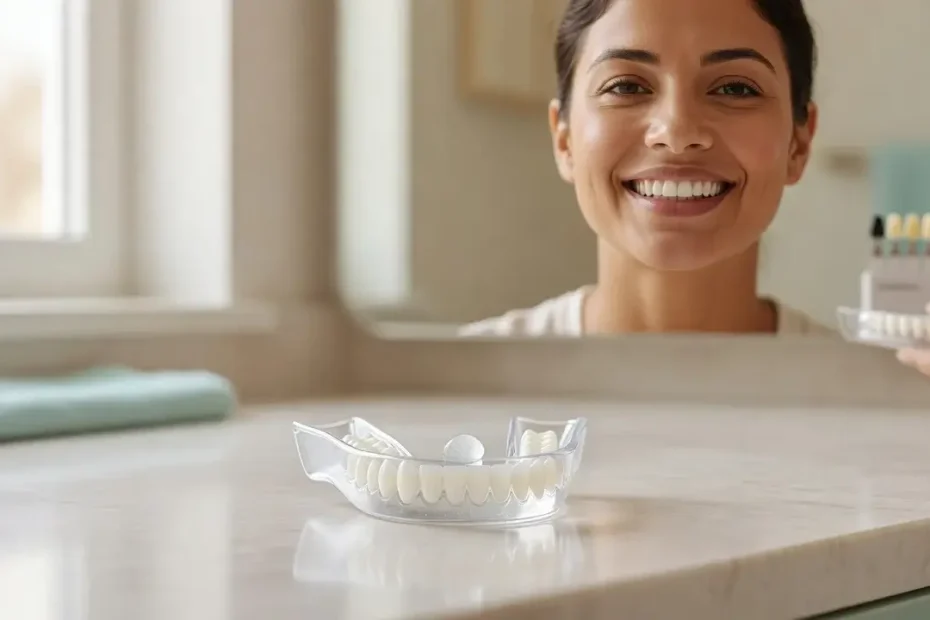
A new shade of yellow on your teeth can make every photo feel less flattering, and online kits make whitening look effortless. Yet a poor fit or too much peroxide can irritate gums and trigger sharp sensitivity, while crowns and fillings will not lighten at all. This guide explains how tooth bleaching works, who should wait, and how to compare options, so you can make a safer plan with a dentist and know what results to expect.
Quick answer: Do whitening trays work?
Yes. Whitening trays can brighten natural teeth when a peroxide gel is used as directed. A custom tray from a dentist can fit closely and help keep gel on the teeth, while store-bought kits may fit less precisely. Results vary with the cause of discoloration, the gel, and how consistently you follow its directions. Existing fillings, crowns, veneers, and bonding do not bleach to a lighter shade. [1]
The safest first step is a dental checkup, especially if you have tooth pain, untreated decay, gum problems, cracks, or dental work on visible teeth. A dentist can identify the source of the color, check whether bleaching suits you, and explain which product and schedule match your mouth. Whitening is cosmetic; it does not repair a cavity or replace routine care.
What are whitening trays, and how do they work?
A whitening tray is a clear mouthpiece that holds bleaching gel against the front surfaces of the teeth. The tray itself does not change tooth color; the active ingredient in the gel does the work. Most bleaching gels use hydrogen peroxide or carbamide peroxide, which releases hydrogen peroxide as it breaks down. [1]
Peroxide moves through enamel and acts on colored compounds inside the tooth. This can make some stains less visible and the natural tooth look brighter. It does not paint a white layer over the enamel, and it cannot change the color of ceramic, resin, metal, or other restorative materials.
A dentist-made tray usually starts with a scan or impression of your teeth. The lab or dental office uses that record to make a mouthpiece shaped for your arches. A dentist then tells you how much gel to use, how long to wear it, and how to respond if your teeth or gums become uncomfortable.
Over-the-counter kits may use a universal tray, a flexible mouthpiece, a boil-and-bite design, or a tray preloaded with gel. Some people find them convenient, but the fit and directions differ by product. Do not assume a gel concentration or wear time from one kit applies to another.
Main types of whitening trays
A professional take-home kit usually combines a dentist-fitted mouthpiece with a dental bleaching gel. The dentist checks your teeth first, selects a plan, and can adjust it if you develop sensitivity or gum irritation. This option gives you professional guidance at home, but it requires an appointment and careful use.
A store-bought tray kit is sold directly to consumers. It may cost less up front and can be easy to find, but a one-size or partly adaptable tray may let gel touch the gums or saliva may wash it away from uneven areas. Read the label, use only the supplied gel, and stop if the tray hurts or causes a reaction.
A dentist may also recommend a different approach, such as whitening strips, an in-office treatment, or no bleaching at all. The best choice depends on your oral health, stain type, sensitivity, budget, schedule, and the appearance you want—not on the most dramatic advertisement.
Custom vs. store-bought trays: what is the difference?
| Feature | Dentist-made take-home tray | Store-bought tray kit |
|---|---|---|
| Fit | Made from a scan or impression; usually shaped to your teeth | Often one-size, flexible, or partly adaptable |
| Gel | Selected or prescribed for your case; follow the dentist’s directions | Included or separately supplied; follow that product’s label |
| Guidance | Dental exam, instructions, and follow-up are available | Usually self-directed; contact a dentist if you have a concern |
| Gum contact | Close fit can help limit gel overflow, though correct loading still matters | Fit may vary and gel may reach the gums more easily |
| Convenience | Requires a dental visit and a short wait for a custom mouthpiece | Available without a custom appointment, depending on local rules |
| Cost | Often higher at the start; the tray may be reusable if the dentist approves | Often lower at the start; replacement kits or refills add cost |
| Good fit for | People who want a tailored plan or need a dentist to assess risk | Adults with healthy teeth who can follow the label and have no warning signs |
| Main caution | Do not change the gel dose or schedule without checking with the dentist | Do not use a poor-fitting tray or exceed the stated wear time |
No option is right for everyone. A lower price does not show that a product is safer, and a custom mouthpiece does not make unlimited use safe. Check the package for its active ingredient, directions, warnings, expiry date, and manufacturer details. If you are unsure whether the product is approved or suitable where you live, ask a local dentist or regulator rather than trusting a social media claim.
What can whitening trays help with?
Peroxide bleaching can improve some yellowing and stains caused by common foods, drinks, aging, and tobacco. It may also help with certain stains that formed within a natural tooth, although internal discoloration can be harder to treat and may need a dentist’s assessment. [1]
Treatment may be useful if you want gradual, at-home whitening and can stick to a measured schedule. Custom take-home care can suit people who prefer to whiten over several days or weeks rather than book an in-office session. The pace and amount of change are not guaranteed: the same product can produce different results for different people.
Bleaching will not make a dental restoration match a newly brightened natural tooth. If a front tooth has a crown, veneer, filling, implant crown, or bonding, ask a dentist how whitening could affect the overall color. Sometimes the dentist needs to plan the shade of future dental work after the natural teeth have reached a stable color.
Who should wait or ask a dentist first?
Arrange an exam before bleaching if you have any of these concerns:
- A cavity, toothache, cracked tooth, loose filling, or a tooth that hurts when you bite.
- Bleeding, swollen, or sore gums; gum disease; mouth ulcers; or recent dental surgery.
- Strong sensitivity to cold, heat, sweets, or brushing.
- A single dark tooth, gray or brown bands, white or brown patches, or discoloration after an injury.
- Several visible crowns, veneers, implants, or tooth-colored fillings.
- A history of reacting to a whitening product or uncertainty about the product’s ingredients.
A dentist may recommend treating decay or gum disease first, changing the plan, or avoiding bleaching. A single dark tooth can signal a problem inside the tooth, so covering it with gel without an exam can delay needed care. A dentist can also explain whether a stain is likely to respond or whether another treatment is more suitable.
Children and teenagers should not use bleaching products without advice from a dentist. Age limits and rules differ by product and country, and young teeth may need a different approach. If you are pregnant or breastfeeding, ask a dentist or healthcare professional before using a cosmetic bleaching product; because whitening is elective and safety information may be limited for your situation, delaying it may be the simplest choice.
What results can you expect?
A realistic goal is a brighter version of your natural tooth color, not a guaranteed paper-white smile. Your starting shade, the reason for the discoloration, the product’s active ingredient, tray fit, exposure time, and consistency all influence the result. Teeth with deep internal stains may change less than teeth with surface discoloration.
The change often appears gradually rather than after one use. Take a baseline photo in steady, natural light if you want to compare progress, and keep the camera distance and setting similar. Tooth color can look different under bathroom lighting, phone filters, or a flash, so do not judge progress from one picture.
A temporary lighter appearance right after treatment may not be the final shade. Teeth can look different as they rehydrate, so ask your dentist when to assess the finished color—especially before matching a crown, veneer, or filling. Whitening can also be uneven when teeth have different stains or restorations.
Results can fade as new stains build up and as teeth naturally change with age. Coffee, tea, red wine, tobacco, and some strongly colored foods can contribute to surface staining. Good brushing and flossing help oral health, but they cannot freeze tooth color or replace dental checkups. Ask your dentist before doing a touch-up; repeating a course too often can increase discomfort without giving a better outcome.
How to use whitening trays safely
Follow the exact instructions supplied with your product or given by your dentist. If the label and a dentist’s instructions appear to conflict, pause and contact the dental office or manufacturer before continuing. A safe routine is measured, not improvised.
- Start with a healthy mouth. Have pain, decay, gum problems, cracks, or loose dental work assessed first. Brush and floss as usual, but do not use bleaching gel to treat an oral-health problem.
- Check the tray and gel. Do not use a cracked, sharp, warped, expired, or poorly fitting mouthpiece. Check the package for the active ingredient and directions, and keep the gel away from children and pets.
- Use only the stated amount. If a dentist has prescribed the gel, use the amount and placement they showed you. For a retail product, follow its own insert. Extra gel will not make teeth whiten faster; it can squeeze onto the gums or be swallowed.
- Seat the tray gently. Do not force a tray that causes pain or pressure. If gel spills over the edge, remove the excess as the instructions allow; do not leave a pool of gel against the gums.
- Wear it for the stated time only. Do not add extra hours, double a missed session, or sleep in a tray unless the product directions or dentist specifically say that is appropriate.
- Remove and clean it as directed. Spit out excess gel and rinse your mouth if the instructions call for it. Clean the mouthpiece with the recommended method, avoid hot water that could distort some plastics, and store it dry and out of children’s reach.
- Watch your mouth. Pause if sensitivity becomes strong, gum tissue turns sore or white, or the tray starts to rub. Contact a dentist for advice before restarting or changing the schedule.
Do not use household bleach, undiluted peroxide, lemon juice, baking soda mixtures, or a gel intended for another purpose in a dental tray. These are not substitutes for a labeled oral-care product. Do not share a mouthpiece; it is made for one person and should stay clean.
How long should you wear them, and when will they work?
There is no single wear time that suits every gel. Carbamide peroxide and hydrogen peroxide products can have different concentrations and instructions, and a dentist-prescribed plan may differ from a retail kit. Follow the schedule for the specific product in your hand rather than copying a routine from a video or another person.
A 2025 randomized clinical trial studied 120 healthy adults using 10% carbamide peroxide in trays for 2, 4, or 8 hours a day over 14 days. The researchers found that the shorter schedules produced similar color change to the 8-hour schedule at the one-month assessment, while sensitivity was similar across groups. This was one study of one gel and a selected group of adults; it is not permission to change your own product’s directions. [2]
Treatment commonly takes repeated sessions, but the exact course depends on the product and the desired shade. If you see little change, do not simply wear the tray longer or add more gel. Check the fit, directions, and likely stain type with a dentist before continuing. You may need a different approach—or you may already be close to the result your teeth can safely achieve.
How to manage sensitivity and gum irritation
Temporary tooth sensitivity and gum irritation are among the most common side effects of peroxide bleaching. They can be linked to the peroxide exposure, a tray that rubs, or gel touching the gums. Mild symptoms may settle after stopping, but strong, persistent, or one-sided pain needs dental advice. [1]
If you notice discomfort, remove the tray and follow the product’s directions for rinsing. Pause treatment and contact your dentist if the pain is sharp, lasts after the tray is out, returns at rest, or is getting worse. The dentist may check for decay or a crack and may recommend a lower concentration, less frequent use, a shorter schedule, or a different treatment. Do not make these changes on your own if the gel was prescribed.
A sensitivity toothpaste may help some people when used as directed, but it is not a guarantee that whitening will be comfortable. In a randomized clinical trial of one 10% carbamide peroxide gel, adding potassium nitrate and sodium fluoride did not reduce sensitivity compared with the gel without those ingredients. That result applies to the tested formula and schedule; it does not prove that every desensitizing ingredient is ineffective. [3]
If gel burns your gums, remove the tray, rinse gently, and do not restart until the tissue feels normal and you have checked the instructions or spoken with a dentist. Blisters, marked swelling, severe pain, or a reaction that does not improve deserve prompt professional advice. If a large amount of product is swallowed or someone has trouble breathing, seek urgent local medical help and follow the product’s emergency directions.
Whitening trays vs. other ways to brighten teeth
| Method | How it works | Strengths | Limits and cautions |
|---|---|---|---|
| Dentist-supervised take-home bleaching | Peroxide gel sits against natural teeth in a fitted mouthpiece | Gradual, adjustable, and supported by a dental exam | Needs consistent use; sensitivity and gum irritation can occur |
| In-office bleaching | A dental professional applies a bleaching product during an appointment | Dentist can protect soft tissues and monitor the process | May cost more; sensitivity can still occur; restorations do not bleach |
| Whitening strips | A peroxide-coated strip contacts the teeth | Convenient and usually simple to apply | May not fit every tooth shape; follow the brand’s directions |
| Whitening toothpaste | Mild abrasives or other ingredients help remove some surface stain | Useful for routine cleaning when used as directed | Usually does not change deeper tooth color like peroxide bleaching |
| Whitening rinse or paint-on gel | A liquid or brush-on product contacts teeth for a short period | Easy to add to a routine if the label supports it | Contact time and coverage may be limited; results differ by product |
| Charcoal, acidic fruit, or DIY recipes | Abrasive or acidic ingredients are promoted as stain removers | Often marketed as inexpensive or “natural” | Can irritate tissue or wear tooth surfaces; not a proven substitute for dental advice |
A dentist can compare these options after checking your teeth and gums. Avoid any method that promises instant permanent whitening, claims it can bleach crowns, or encourages you to ignore pain. For a healthy smile, a small gradual change is safer than chasing the brightest possible shade.
How to choose a product or dentist-led plan
Use this checklist before you buy or book:
- Find the active ingredient. Look for the named bleaching agent and concentration, plus clear directions. Do not buy an unlabelled gel or rely on an online seller’s verbal claims.
- Read every warning. Check age limits, use restrictions, expiry date, storage requirements, and what to do if gel reaches the gums or is swallowed.
- Check the fit. A tray should not cut, pinch, or make it hard to close your mouth. Stop using it if it hurts or repeatedly leaks gel.
- Ask what happens if you react. Know whom to contact and whether you can get a dental review. A responsible provider explains limits as well as benefits.
- Consider all visible dental work. Ask how natural teeth and restorations may look together after treatment, and whether a restoration might need a separate shade plan.
- Compare total cost, not just the first price. Include the consultation, custom mouthpiece, gel refills, replacement trays, and follow-up if relevant.
- Ignore pressure tactics. Be cautious of countdown deals, guaranteed shade claims, influencer “prescriptions,” and advice to use a stronger gel more often.
If you choose a dentist-made plan, ask what active ingredient is being used, how long to wear the tray, how many days to treat, and when to call. Ask whether you need dental work completed first and how the plan accounts for existing sensitivity. Clear answers are a sign that your comfort and oral health matter—not just the cosmetic result.
How to protect your results after treatment
Brush twice a day with a fluoride toothpaste and clean between the teeth daily. These habits help prevent decay and gum disease, although they do not guarantee a specific shade. Keep routine dental visits so a professional can check your mouth and remove hardened deposits that a toothbrush cannot.
To limit new surface stains, rinse with water after dark drinks when practical and avoid tobacco. You do not need to remove every favorite food from your diet. Small, sustainable habits are easier to keep than strict rules, and no drink or food needs to be blamed for every change in color.
Wait until your dentist says it is time before arranging a shade match for new visible dental work. Tell the dental team that you have recently bleached your teeth; they can advise when the color is stable enough for planning. Do not repeat a full bleaching course just because the first-day shade softens slightly.
Common mistakes to avoid
- Using too much gel: This wastes product and can expose gums to more peroxide. Follow the measured amount, not the urge to fill the tray.
- Extending wear time: Longer exposure is not automatically better. More contact may raise the chance of irritation without producing a proportionate improvement.
- Ignoring pain: Sensitivity can be temporary, but pain can also point to a separate dental problem. Stop and get advice when symptoms are strong, lingering, or unusual.
- Whitening before a checkup: A cavity, crack, or inflamed gum can make treatment uncomfortable and complicate the result.
- Expecting dental work to change color: Crowns and fillings keep their existing shade. Plan for restorations with a dentist.
- Mixing products: Combining different gels, strips, rinses, or home recipes makes it harder to know the dose and may irritate the mouth.
- Repeating treatments too often: Use a touch-up only when a dentist or the product directions say it is suitable for you.
- Trusting dramatic before-and-after photos: Lighting, camera filters, dehydration, and editing can make a result look stronger than it is.
Frequently asked questions
1. Do whitening trays work on yellow teeth?
Yes, peroxide bleaching can brighten many natural teeth with yellow discoloration. How much they change depends on why they are yellow and the product used. A dentist should assess persistent, patchy, or sudden color changes before you start.
2. How long does it take to see a difference?
Many products work gradually over repeated sessions, but the schedule varies by gel and person. Follow the instructions on your exact kit or the plan from your dentist. If the shade is not changing, do not increase the dose or wear time without advice.
3. Are whitening trays better than strips?
Neither is best for everyone. A fitted tray can hold gel around several teeth and may be customized, while strips are convenient and do not require a mouthpiece. Fit, product directions, stain type, and your oral health matter more than the format alone.
4. Can I use whitening trays if I have crowns or fillings?
You may be able to whiten natural teeth, but bleaching does not lighten crowns, veneers, fillings, bonding, or implant restorations. This can make color differences more noticeable. Ask a dentist to plan treatment if dental work shows when you smile.
5. What should I do if my teeth become sensitive?
Remove the tray and pause treatment. Follow the product’s directions, then contact a dentist if the discomfort is strong, continues after treatment stops, affects one tooth, or keeps returning. Do not try to push through worsening pain.
6. Can I sleep in whitening trays?
Only if the exact product instructions or your dentist specifically say that overnight wear is appropriate. Many products are designed for shorter use. Never assume that a tray is safe to sleep in because another brand or person uses it that way.
Take the next step toward a brighter, healthier smile
A good whitening plan begins with healthy teeth, realistic expectations, and directions you can follow. Before buying a kit, book a dental checkup if you have pain, gum problems, visible restorations, or unexplained discoloration. If you are a suitable candidate, ask a dentist which product, wear time, and review plan fit your mouth. Choose steady progress over shortcuts, and stop if your teeth or gums tell you something is wrong.