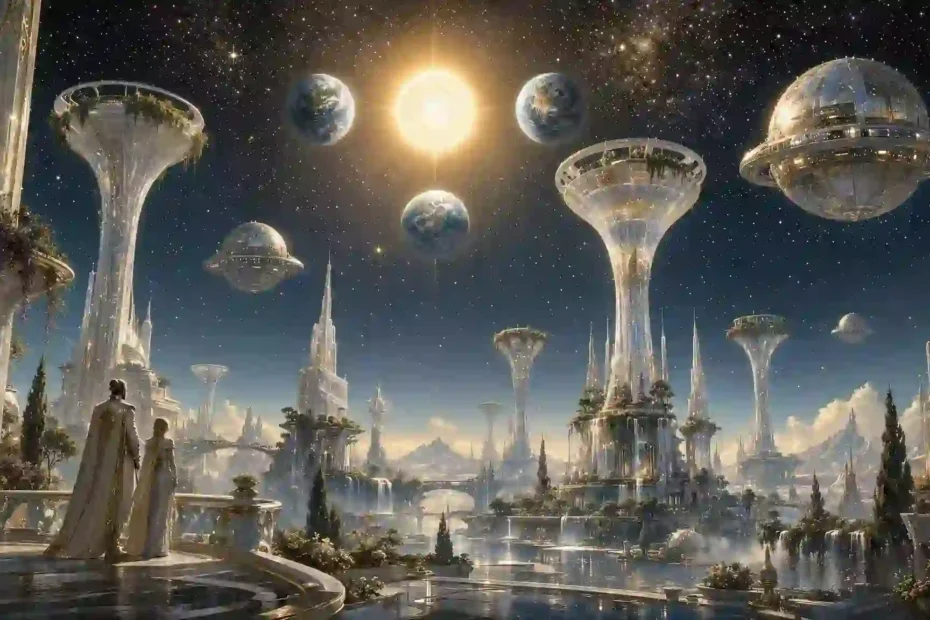
You search for Arkon images and find scattered covers, blurry scans, and fan posts with zero context. That gap hurts, because Arkon ranks among the most striking places in science fiction. You do not understand why crystal towers are present in every scene and why three planets share an orbit if you do not know the backstory. This guide fixes that. It explains Perry Rhodan Arkon System Art world by world and artist by artist, using facts taken straight from the novels.
What Is Perry Rhodan Arkon System Art?
Perry Rhodan Arkon System Art is the collection of illustrations that show the home star system of the Arkonides in the German science fiction series Perry Rhodan. It includes magazine covers, interior drawings, technical cutaways, book jackets, posters, and fan paintings.
Short answer: It is the visual world of Arkon, painted by official cover artists and fans since 1961, built around three planets in a triangle, funnel-shaped cities, and spherical starships.
The subject stays remarkably consistent across six decades. Artists return again and again to the same core motifs:
- A hot, bright yellow-white sun at the heart of a crowded star cluster
- Three planets sharing one orbit in a perfect triangle
- Gleaming funnel-shaped buildings rising from green parkland
- Huge spherical warships, the classic Arkonide design
- Tall, white-haired Arkonides with reddish eyes and aristocratic poise
Each generation of painters added its own style. The motifs, however, never changed, and that steady visual identity explains why fans recognize Arkon in a single glance.
Where Is the Arkon System Located in the Perry Rhodan Universe?
Arkon sits almost at the exact center of the globular cluster M13 in the constellation Hercules. The Arkonides call this cluster Thantur-Lok. The series places Arkon roughly 34,000 light-years from Earth’s solar system.
A real object grounds this fiction. M13 is a genuine globular cluster that you can spot with binoculars on clear summer nights. Its actual distance is estimated by astronomers to be between 22,000 and 25,000 light-years, hence the writers exaggerated the truth for dramatic effect.
Here are the key facts about the Arkon star itself:
- Spectral class: A8V, a large, hot, bright yellow-white sun
- Original planets: 27 planets and 159 moons
- Political role: Part of the ten-light-year central sector of the Great Empire
- Alternate name: The Naats call the star Baag
This location matters for every painter. A globular cluster packs thousands of suns into a small space, so the Arkon sky never looks truly dark. Many classic covers show a glittering backdrop of stars behind the planets, and that detail comes straight from the setting. In Perry Rhodan Arkon System Art, this star-filled sky works like a signature, telling readers they have left the quiet outer arms of the galaxy behind.
How Do the Three Worlds of Arkon Shape the Artwork?
The single most famous feature of the system is the Tiga Ranton, the three synchronized worlds. Arkon I, Arkon II, and Arkon III share one orbit and circle the sun at about 620 million kilometers. They form an equilateral triangle as they travel.
According to Perry Rhodan issue 39, the orbits are circular and the planets have no axial tilt. That means no seasons at all. Temperatures stay near 34 degrees Celsius all year long.
This arrangement is artificial. Arkonide engineers fitted entire planets with giant impulse engines and pushed them into a shared orbit. Later generations spread the claim that the triangle had always existed, a piece of propaganda meant to raise Arkonide prestige across the Milky Way.
For artists, the triangle creates a signature composition. Show three similar planets evenly spaced around a bright sun, and readers know the location instantly. Few fictional star systems own a shape this clear.
What Does Arkon I, the Crystal World, Look Like?
Arkon I carries the name Crystal World. It serves as the home of the ruling elite and the political heart of the empire. Its look defines Arkonide style more than any other planet.
The trademark structures are funnel-shaped buildings. They stand narrow at the base and open wide at the top, like giant glasses rising from the landscape. Wide parks, gardens, and open terraces fill the space between them.
The Crystal Palace, seat of the Arkonide emperor, stands on the Hill of the Wise. Artists usually paint it as a shining complex of towers and domes that catches the light of the white sun.
Typical visual elements of Arkon I include:
- Funnel towers with terraces and hanging gardens
- Wide boulevards and calm, almost empty plazas
- Glassy, reflective surfaces that suggest crystal
- Bright, warm light with soft shadows
- Lush green landscaping, made possible by the steady warm climate
The overall mood feels clean, wealthy, and slightly cold. Good Perry Rhodan Arkon System Art captures that contrast between beauty and a ruling class that has grown tired and proud.
What Makes Arkon II and Arkon III Look Different?
Arkon II serves as the Trade World. Artists fill it with spaceports, cargo docks, huge warehouses, and busy markets. Crowds of alien merchants, freight ships, and transport gliders give it a noisy, commercial energy that Arkon I never shows.
Arkon III, the War World, carries a darker visual tone. It held shipyards, fortresses, weapon plants, and the famous Robot Regent. This giant positronic computer took control of the empire as the Arkonides themselves lost their drive.
Arkon III met a dramatic end. Perry Rhodan issue 199, published in 1965, describes its destruction by the Blues in the in-story year 2329. A new Arkon III appears much later in the series timeline, during the era counted in NGZ years.
This history gives painters two very different subjects:
- Before 2329: Industrial landscapes, massive hangars, and the cold intelligence of the Robot Regent
- The destruction: Fire, debris, and a broken triangle in the sky
- The later era: A rebuilt world that restores the classic three-planet shape
What Defends the Arkon System, and How Do Artists Show It?
The system has a powerful outer shield called the Outer Fortress Ring. It lies about 15 to 20 light-hours from the sun. Perry Rhodan issue 38 describes roughly 5,000 huge, heavily armed platforms in this ring, some built inside hollowed-out asteroids.
This ring inspires some of the most exciting battle scenes in the series. Artists show Terran ships slipping past glowing platforms, energy beams cutting through space, and the bright Arkon sun waiting in the distance.
These scenes also tell a story about scale. A ring of thousands of fortresses spread across light-hours shows how rich and powerful the Arkonide Empire once was. Painters use tiny ships against giant stations to make that power feel real.
Who Are the Arkonides, and Why Do They Matter in the Art?
The Arkonides are a humanoid people with white or silver hair and reddish eyes. They look much like humans, yet their pale coloring and calm, proud posture set them apart at once.
Readers met them in the very first issue, “Unternehmen Stardust,” published in 1961 and written by K.H. Scheer. Perry Rhodan finds a stranded Arkonide research ship on the Moon, commanded by Thora and carrying the scientist Crest. That first contact starts the entire saga.
Atlan, the Crystal Prince, became the most loved Arkonide character. He even received his own spin-off series. Artists often place him in front of Arkon’s towers, linking the hero to his home world.
When painters show Arkonides, they tend to use:
- Long robes or elegant, close-fitting uniforms
- Silver and white hair that catches the light
- Upright, regal body language
- Pale skin tones set against warm gold and white architecture
The people and the planets share one visual language. Both look refined, bright, and a little distant.
Which Artists Created the Most Famous Arkon Images?
Several cover artists shaped how fans picture Arkon. Their names appear in the imprint of every issue, which makes the record easy to check.
Johnny Bruck painted the covers from issue 1 through issue 1799. After his death in 1995, the final covers in that range used finished work or existing material. His bold painted spheres, glowing suns, and dramatic lighting defined the look of the series for more than thirty years.
Alfred Kelsner took over with issue 1800. His smooth, realistic style brought a more modern finish to ships and planets.
Swen Papenbrock started with issue 1806. He became known for rich color and strong character portraits.
Dirk Schulz joined with issue 2134. His work blends cinematic lighting with detailed technology and has a strong comic and film feel.
Ralph Voltz and Arndt Drechsler also created many covers in later decades, each adding a fresh take on Arkonide ships and worlds.
Fans who study Perry Rhodan Arkon System Art often start with Bruck, because his covers set the visual rules that every later artist followed or bent.
Comparison Table: Arkon Art Across the Eras
| Era | Main Cover Artists | Typical Technique | How Arkon Looks | Best For Collectors |
|---|---|---|---|---|
| 1961 to 1995 | Johnny Bruck | Hand-painted covers | Bold colors, glowing suns, hard-edged spheres | Original first-print issues |
| 1995 to early 2000s | Alfred Kelsner, Swen Papenbrock, Ralph Voltz | Painted and airbrush styles | Smoother light, more realistic planets | Cycle anniversary issues |
| 2000s to 2010s | Dirk Schulz, Swen Papenbrock, Alfred Kelsner | Digital painting | Cinematic angles, detailed cities | Posters and art prints |
| 2010s to today | Dirk Schulz, Arndt Drechsler, Alfred Kelsner | Digital painting and 3D tools | Film-like scenes, rich detail | Modern issues and special editions |
| Ongoing | Fan artists worldwide | Every medium | Personal takes on the triangle and towers | Conventions and fan clubs |
This table shows a clear pattern. Tools changed from brush to tablet, yet the same three-planet triangle and funnel towers appear in every era.
How Did the Art Style Change From the 1960s to Today?
The early covers drew on the energy of pulp magazines. Bright primary colors, strong outlines, and heroic poses sold the issues from newsstand racks. Arkon looked exotic and grand, with sharp contrasts between black space and blazing suns.
During the 1990s and 2000s, the style moved toward realism. Artists used smoother gradients, softer light, and more believable planet surfaces. Ships gained surface detail, and cities gained depth.
Today, digital painting and 3D tools rule the field. Covers look like film stills, with dramatic camera angles and atmospheric haze. Modern Perry Rhodan Arkon System Art often shows the triangle from a planet’s surface, so readers feel like they stand under Arkon’s sky.
Three trends stand out across the decades:
- Light: From hard spotlight effects to natural, sun-driven lighting
- Scale: From single ships to vast scenes with cities and fleets
- Mood: From pure adventure to deeper themes of empire, decline, and memory
What Visual Elements Define Arkonide Design?
Arkonide design follows a few clear rules. Learn them, and you can recognize Arkonide work in any image.
- The sphere: Arkonide starships are spheres, often with a ring-shaped bulge around the middle. They range from small boats to giant battleships.
- The funnel: Buildings open upward like funnels, symbolizing wealth and calm order.
- The crystal: Reflective, glassy surfaces suggest perfection and age.
- The triangle: The three-planet layout acts as a logo for the entire system.
- The color scheme: which contrasts with the profound black of space, is dominated by white, silver, gold, and pale blue.
These choices tell a story. Spheres and funnels feel smooth and balanced, matching a culture that sees itself as old, wise, and superior. Artists who respect these rules produce images that feel true to the books.
Why Are Technical Cutaway Drawings So Important to Arkon Fans?
Perry Rhodan issues have long featured detailed cutaway drawings, known in German as Risszeichnungen. These drawings slice open a ship, station, or vehicle and label each part, from engines to crew decks.
Arkonide sphere ships rank among the most popular subjects. A single drawing can show power plants, hangars, weapon domes, and living quarters, all fitted inside the sphere.
These drawings add a layer of believability that few series match. They turn fantasy machines into objects that feel engineered. Many collectors treat them as a separate branch of Perry Rhodan Arkon System Art and save every one they find.
How Does Perry Rhodan Neo Reimagine Arkon?
Perry Rhodan Neo launched in 2011 as a fresh retelling of the saga. It moves the first Moon mission to 2036 and rebuilds the story for modern readers.
Arkon plays a big role in Neo, and its covers present Arkonide ships, worlds, and characters in a modern digital style. New readers often meet Arkon here first.
For art fans, Neo offers a useful comparison. You can place a classic Bruck cover beside a Neo cover and watch how sixty years of design thinking changed the same subject. That side-by-side view turns Perry Rhodan Arkon System Art into a living design history, where each version answers the one before it.
The comparison also helps new artists. It shows which details count as core identity, such as the spheres and the triangle, and which details stay open to fresh interpretation, such as clothing, city lighting, and ship surface detail.
How Can You Collect Perry Rhodan Arkon System Art?
Arkon art collecting might begin modestly and develop into a significant pastime. Follow these practical steps:
- Start with original issues. Early issues that feature Arkon, such as numbers 38, 39, and 199, carry both the story and Bruck’s covers.
- Add hardcover collections. The long-running hardcover editions, known to fans as Silberbände, collect the stories with their own cover art.
- Look for official prints and posters. The publisher and fan shops release art prints of famous covers.
- Check provenance for original paintings. Original cover paintings appear at auctions now and then. Ask for proof of origin before you buy.
- Store items with care. Use acid-free sleeves and keep paper out of direct sunlight to stop fading.
Fan clubs and conventions also help. Fellow collectors trade issues, share scans, and spot rare items faster than any search engine.
How Can You Create Your Own Arkon Fan Art?
Drawing Arkon yourself is one of the best ways to understand it. These steps give you a strong start:
- Read the source. Issues 38 and 39 describe the system in detail. Take notes on the sun, the orbits, and the cities.
- Sketch the triangle first. Place three planets around the sun with even spacing. This anchors the whole scene.
- Choose the right palette. Use white, gold, silver, and pale blue for Arkonide structures.
- Add a crowded sky. Remember that Arkon sits inside a dense star cluster, so fill the background with stars.
- Show scale. Put a tiny ship or person in the frame to make towers and planets feel huge.
- Respect the rights. The characters and designs belong to the publisher. Personal fan art is a long fan tradition, but check the publisher’s rules before you sell any work.
Practice builds skill fast. Post your work in fan groups and ask for honest feedback on accuracy and mood.
Why Does Arkon Art Still Matter to Science Fiction Fans?
Perry Rhodan began in 1961, created by K.H. Scheer and Clark Darlton, the pen name of Walter Ernsting. Pabel-Moewig Verlag still publishes a new issue every week, and the main series has passed 3,300 issues. That makes it the longest-running science fiction series in the world.
Arkon sits at the center of that story. It was the first great alien civilization that Perry Rhodan met, and its art set the visual tone for everything that followed.
Perry Rhodan Arkon System Art also tells a human story. It shows a proud empire at its peak, its slow decline, and its rebirth. That emotional arc keeps fans coming back to the same images decade after decade.
Frequently Asked Questions
1. What is Perry Rhodan Arkon System Art?
Perry Rhodan Arkon System Art covers all the illustrations of the Arkonide home system, including covers, cutaways, and fan paintings. It centers on three planets in one orbit, funnel cities, and sphere ships.
2. Where is the Arkon system located?
Arkon lies near the center of the globular cluster M13 in Hercules. The series puts it about 34,000 light-years from Earth.
3. Who painted the classic Arkon covers?
Johnny Bruck painted the covers from issue 1 to issue 1799. Alfred Kelsner, Swen Papenbrock, Dirk Schulz, and others followed.
4. Why do three Arkon planets share one orbit?
Arkonide engineers moved two planets into the orbit of the home world with giant engines. The result is a perfect triangle around the sun.
5. What happened to Arkon III?
The Blues destroyed Arkon III in the in-story year 2329, as told in issue 199. A new Arkon III appears much later in the series.
6. Where can I find Perry Rhodan Arkon System Art to collect?
Start with original issues 38, 39, and 199, then add hardcover editions, official prints, and posters. Fan clubs and conventions often offer rare finds.
Start Your Own Journey to Arkon
Arkon proves that a great setting can inspire artists for more than sixty years. The triangle of worlds, the funnel towers, and the shining spheres still spark new paintings every year.
Now it is your turn. Pick up issue 38 or 39, study a classic Bruck cover, and sketch your own view of the Crystal World. Then share it with fellow fans and tell them which era of Perry Rhodan Arkon System Art speaks to you most. Your take could become someone else’s favorite image of Arkon.