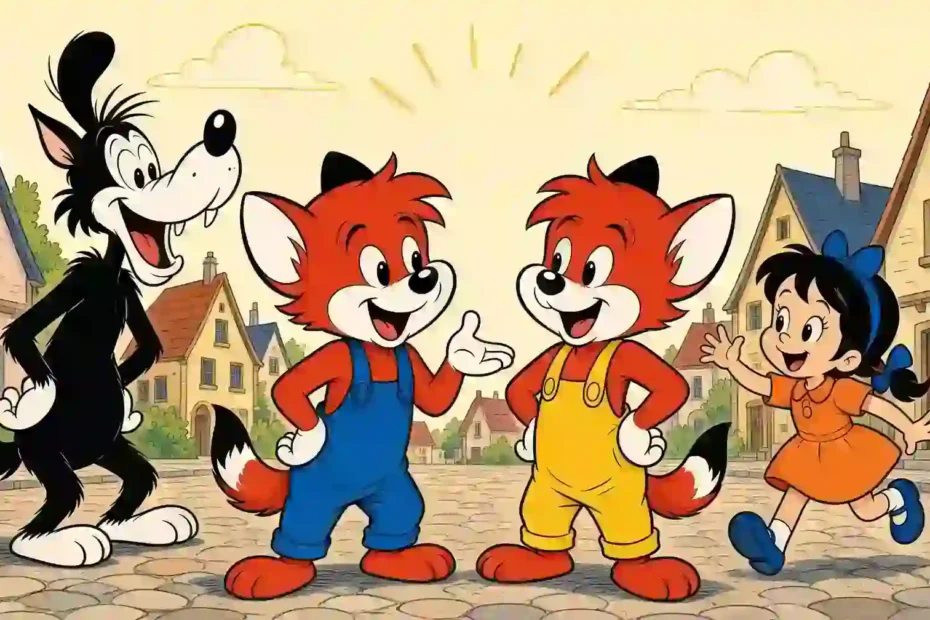
Trying to identify the characters in an old Fix and Foxi comic can be confusing. The twins look alike, familiar faces appear under German names, and television designs do not always match older drawings. This guide to Fix Und Foxi Figuren clears up those differences, introduces the main cast, and shows how their personalities, relationships, and comic history fit together.
What Are Fix Und Foxi Figuren?
Fix Und Foxi Figuren are the fictional characters associated with Rolf Kauka’s Fix and Foxi comics, led by the fox twins Fix and Foxi. Their core supporting cast includes Lupo, Lupinchen, Oma Eusebia, Uncle Fax, and Professor Knox.
The German word “Figuren” means “characters” in this guide, rather than collectible statues or toys. The focus here is who the characters are, what they contribute to the stories, and how to recognize them across different versions.
This style is often called funny-animal comics: animal characters talk, dress, and behave like people. It lets fox brothers, a wolf, and a raven share an everyday world with familiar friendships and family situations.
Meet the Main Cast: A Detailed Character Table
This table separates character identity from storytelling role. The personality contrast between Fix and Foxi follows the official television description, while the classic supporting-cast descriptions draw on the museum’s exhibition record.
| Character | Identity | Main personality or defining feature | Place in the stories | Useful recognition advice |
|---|---|---|---|---|
| Fix | One of the fox twins | Daring and quick to act in the official TV description | Helps move an adventure forward through action | Confirm his name in dialogue; use the relevant edition’s design as a second clue |
| Foxi | Fix’s twin brother | More careful and thoughtful in the official TV description | Balances action with planning and concern for his brother | Avoid assuming that one clothing rule applies to every edition |
| Lupo | A wolf and friend of the twins | Hunger, laziness, and comic mischief shape his classic character | Creates trouble, joins adventures, and sometimes needs help | His long snout provides a stronger visual clue than a particular outfit |
| Lupinchen | A young female member of the supporting cast | Quick-witted in the museum’s character description | Adds her own reactions and decisions to group stories | Learn her name and actions rather than treating her as background decoration |
| Oma Eusebia | The cast’s grandmother figure | Traditional attitudes distinguish her classic role | Brings an older generation’s expectations into the comedy | “Oma” means “grandmother”; it is part of her familiar character name |
| Uncle Fax | The adult family figure called Onkel Fax in German | The museum describes him as good-natured | Adds a family and adult perspective around the twins | “Onkel Fax” and “Uncle Fax” refer to the same character |
| Professor Knox | An inventive raven | Invention and technical curiosity define him | Opens the door to devices, experiments, and unusual problems | Identify the bird character and check the story’s naming |
| Pauli | A mole from Kauka’s wider character cast | Has a character identity beyond the fox twins | Appears in the broader comic world, including a museum-documented production example | Check the strip title and context instead of assuming he belongs to the twins’ family |
The historical cast and setting follow primary source 1, the production example follows primary source 2, and the television personalities follow primary source 3. These records describe different parts of the franchise, so the table does not treat every detail as universal across all editions.
Who Created the Characters, and When Did They Begin?
Rolf Kauka created the Fix and Foxi brand and its central characters. The twins appeared in 1953 in the early Eulenspiegel comic publication, initially as supporting figures before becoming the main attraction. Primary source 1 documents that early development.
Their rise changed the focus of the publication. Two appealing fox characters could carry their own adventures, while a growing supporting cast gave writers more ways to build jokes and conflicts.
Kauka’s name does not mean that he personally drew every published page. The museum explains that teams of artists worked under the Kauka name, which makes individual story credits important when you study the artwork.
A helpful historical outline looks like this:
- 1953: The fox twins enter the early comic publication and develop into leading characters.
- From the 1960s: The magazine also carries licensed Franco-Belgian series alongside its own characters.
- 2010: A print edition later discussed by artist Bone Buddrus provides examples of the production process.
- 2018: LUDWIGGALERIE Schloss Oberhausen presents an exhibition with original drawings, documents, magazines, and films.
This history helps explain why Fix Und Foxi Figuren do not have one unchanging visual form. Different artists and production periods contributed to the characters readers recognize today.
How Can You Tell Fix and Foxi Apart?
The most reliable way to identify the twins is to combine their names, actions, and the design used in the specific publication. One isolated detail, such as clothing color, does not replace that context.
An identification rule should fit the edition in front of you. The official television description makes Fix the more daring brother and Foxi the brother who thinks before acting, but that contrast does not replace direct evidence from an older comic scene.
Follow these steps when examining a page:
- Read the speech balloons. Another character may address a twin by name.
- Check nearby panels. A name mentioned earlier can settle a later image.
- Compare artwork from the same edition. Keep your visual reference consistent.
- Use behavior as supporting evidence. A cautious reaction is a clue, not proof by itself.
The museum’s 2018 workshop account discusses Foxi’s yellow dungarees within a particular print style guide. That provides a documented example, not a promise that every licensed illustration follows the same clothing details.
Who Is Fix, and What Makes Him Important?
Fix is one of the two fox brothers at the center of the series. The official Fix&Foxi Show description presents him as a daring character who readily steps into adventure.
That action-first role gives a scene momentum. When you read a story, watch who makes the first move, accepts a challenge, or pushes an ordinary situation toward something unexpected.
Confidence does not make a character right about everything. A useful reading question is whether his quick decision solves the problem or creates a new one for the group.
Look for three things when following Fix:
- What catches his attention at the start of the scene.
- What he chooses to do before the others react.
- How his brother or friends respond to that choice.
These observations tell you more than a simple label such as “the brave twin.” They help you see how his role works inside the particular story you are reading.
Who Is Foxi, and How Does He Balance His Brother?
Foxi is Fix’s twin brother, not an unrelated fox with a similar name. In the official television description, he thinks before jumping into action and tries to keep his brother out of trouble.
That careful approach gives the audience a second point of view. Where a bold decision starts an adventure, a thoughtful response can reveal the risk, suggest another route, or bring attention back to the group’s needs.
Do not confuse caution with weakness. Thinking ahead can demand as much courage as making the first move, especially when a character must challenge an exciting but unwise plan.
When comparing the brothers, ask what each one contributes. Their partnership becomes easier to understand when you look for cooperation rather than trying to decide which twin is always smarter or better.
The television summary emphasizes that they remain together through difficult adventures. Their shared loyalty matters more than a rigid personality checklist.
Why Is Lupo More Than a Trouble-Maker?
Lupo is one of the easiest Fix Und Foxi Figuren to recognize because of his wolf identity and long snout. The museum’s classic cast description highlights his appetite and laziness, while the official television summary identifies him as the twins’ friend.
Those traits offer a strong base for comedy. A character who wants a reward without much effort can clash with a plan that requires patience, work, or self-control.
However, “comic trouble-maker” does not mean “permanent villain.” Lupo can belong to the group, cause problems within it, and still deserve help when another danger appears.
The museum’s account of Bone Buddrus’s workshop gives a concrete example. In a production scene, bandits carry Lupo away on a sled while Oma Eusebia, Lupinchen, and Pauli pursue them.
That example shows why a single character label falls short. Lupo’s role depends on the scene: the person who creates a problem in one adventure can become the person others try to rescue in another.
When reading his scenes, separate the joke from the relationship. His appetite may drive the comedy, but the group’s response tells you how he fits into their world.
Who Is Lupinchen, and Why Should Readers Notice Her?
Lupinchen belongs to the classic supporting cast around the twins. The museum describes her as quick-witted, which gives readers a better starting point than merely identifying her as the girl in a group picture.
Pay attention to what she notices and decides. A character’s importance comes from her contribution to the scene, not simply from how often she appears beside the leading pair.
The workshop’s pursuit scene also includes Lupinchen among the characters taking action. That documented example makes her participation clear without inventing a personality rule for every comic.
A simple way to follow her role is to ask:
- Does she understand something another character misses?
- Does her response change what the group does next?
- Does she join the action rather than just comment on it?
These questions help readers appreciate the supporting cast on its own terms. They also prevent the twins from becoming the only characters a beginner remembers.
What Role Does Oma Eusebia Play?
“Oma” is the German word for grandmother, and Oma Eusebia brings an older generation into the cast. The museum’s classic description presents her as conservative, making traditional expectations an important part of her role.
That difference in outlook can create comedy without turning her into an enemy. Young characters and older family figures can disagree about behavior, responsibility, or what counts as a sensible decision.
Watch how a scene handles those disagreements. The humor may come from the gap between a character’s plans and the standards another person expects them to meet.
Eusebia is not limited to standing beside the action. The museum-documented chase example places her directly in the pursuit, which shows why readers should follow her actions as well as her authority.
For younger readers, explain the name before the scene. Knowing that “Oma” means grandmother makes the family tone easier to understand without a long translation lesson.
Who Is Uncle Fax, Also Called Onkel Fax?
Uncle Fax is the English rendering of Onkel Fax. “Onkel” means “uncle,” so these names do not identify two different characters.
The museum places him in the twins’ familiar setting and describes him as good-natured. His adult family role adds another perspective to a cast otherwise driven by young heroes, comic mischief, and unusual inventions.
When he appears, notice how the younger characters explain themselves to him. A scene can change its tone when an adult listens to a plan, questions it, or joins the events around the group.
Avoid mixing up a family role with a fixed level of competence. Read the particular scene before deciding whether Fax provides guidance, comic contrast, or another complication.
Learning both forms of his name helps when comparing German comics with English descriptions. Keep the character identity constant even when a translated name changes the wording.
Why Is Professor Knox Central to the Comic World?
Professor Knox is the inventive raven in the classic supporting cast. His character adds a technical and imaginative side to a world built around friendship, family, and everyday comic situations.
Among Fix Und Foxi Figuren, Knox gives readers a clear route into invention-led stories. A new device or unusual experiment can introduce a problem that ordinary household comedy would not create.
When reading such a scene, begin with the invention’s purpose. Then ask how the other characters use it and whether the result matches what the inventor intended.
That reading method distinguishes an object from its storytelling function. A machine matters because it changes choices, creates consequences, or gives the group something new to understand.
Knox also makes the wider cast easier to remember. The twins lead the adventures, Lupo brings comic appetite and shortcuts, and the inventive raven adds another distinct source of story ideas.
How Do the Characters’ Relationships Shape the Stories?
The relationships among Fix Und Foxi Figuren explain more than a list of names alone. Friendship, family roles, and contrasting habits give a small cast many different ways to interact.
Begin with the clearest connection: Fix and Foxi are twin brothers. The official television description also identifies Lupo as their friend, so he should not automatically appear under a list of enemies.
Then notice how different combinations change a scene. Pairing an impatient character with a careful one produces a different exchange from pairing an inventor with someone eager to try a device.
Use this reading checklist:
- Shared goal: What does each person want to achieve?
- Difference: What habit or expectation separates them?
- Decision: Who changes the group’s next step?
- Response: Do the others help, object, or create a new problem?
A full family tree requires edition-specific evidence for every branch. For a first reading, the confirmed brotherhood, familiar family titles, and friendship connections provide a clear foundation without unsupported genealogy.
What Is Fuxholzen?
Fuxholzen is the fictional small-town setting associated with the core cast. The museum’s exhibition record places the twins and their familiar supporting characters in this shared environment.
For readers exploring Fix Und Foxi Figuren, the setting explains why the same faces can meet again across different adventures. A recurring town creates continuity even when the immediate problem changes.
Read the surroundings as part of the story. A familiar room, a street, or an outdoor route can affect who sees an event, who arrives in time, and how a joke develops.
Fuxholzen is a fictional place, not a real destination with one official street map that every story must follow. Use the published artwork to understand the scene in front of you rather than inventing geography beyond the available evidence.
Which Other Characters Belong to the Wider Magazine?
A guide to Fix Und Foxi Figuren should distinguish the central cast from everything printed in a magazine bearing the twins’ name. Sharing a publication does not make every character part of the same family or fictional setting.
Pauli belongs to Kauka’s broader character world and appears in the museum’s production example. A reader should still examine the strip title and context rather than assuming that every appearance works in exactly the same way.
The magazine also published licensed Franco-Belgian series from the 1960s onward. The museum names Gaston, Asterix, the Smurfs, Lucky Luke, and Spirou and Fantasio among those series.
| Category | Examples | What the distinction means |
|---|---|---|
| Central fox-twin cast | Fix, Foxi, Lupo, Lupinchen, Oma Eusebia, Uncle Fax, Professor Knox | These characters form the core group covered by this guide |
| Wider Kauka cast | Pauli | A related character can have his own identity and story context |
| Licensed magazine series | Asterix, the Smurfs, Lucky Luke, Gaston, Spirou and Fantasio | Publication in the magazine does not mean Kauka created these characters |
Check the story heading and creator credits before making an attribution. This small habit prevents a major mistake: treating a magazine’s entire contents as the work of one creator.
How Do Comic and Television Versions Differ?
Fix Und Foxi Figuren appear in both print and screen contexts, but the two formats communicate in different ways. Comics rely on selected images and reader-controlled pacing, while television adds movement, voices, sound, and fixed timing.
The official Fix&Foxi Show description presents the brothers as confident, adventurous ten-year-olds rather than superheroes. That age belongs to the cited television description; it should not become an unsupported rule for every historical publication.
| Feature | Printed comic | Television adaptation |
|---|---|---|
| Pace | The reader controls how quickly to move between panels | Editing and performance set the viewing pace |
| Dialogue | Speech balloons carry the words | Voice performance adds tone and emphasis |
| Movement | Selected poses suggest the action | Animation shows movement across time |
| Identification | Dialogue, captions, and edition-specific artwork provide clues | Spoken names, voices, and screen designs provide clues |
| Comparison method | Check the issue and story credits | Check the specific series or episode |
Neither format should serve as an automatic correction of the other. Compare the version you actually have, and describe any difference precisely instead of calling it an error without evidence.
Why Do Drawings and Character Designs Change?
The appearance of Fix Und Foxi Figuren reflects the work of different artists and production teams. The museum’s exhibition traces the development from earlier drawings to the familiar comic characters, while its workshop account explains how artists maintain consistency within a production.
Bone Buddrus’s 2018 workshop describes a style guide that sets details such as relative height, clothing colors, movement, and character design. The account also explains that these visual guidelines change with the tastes of a particular period.
Comic production involves several distinct jobs:
- Writing: The writer establishes the story and dialogue.
- Planning: The team arranges the action across panels.
- Drawing and inking: Artists develop the final line work.
- Coloring: Color choices establish the finished appearance and mood.
- Review: The production team checks the page against its requirements.
A different drawing style does not, by itself, prove that a character is unofficial. Check publication details and rights information when authenticity matters, and avoid treating visual similarity as a complete test.
For artwork study, compare examples from a defined period first. You will learn more from a careful comparison than from mixing unrelated images and searching for one rule that covers them all.
What Makes the Humor Easy to Follow?
The cast gives readers several clear sources of contrast: action and caution, appetite and restraint, youthful plans and older expectations. These differences help explain a joke without requiring a long account of every character’s past.
Follow the cause-and-effect chain instead of rushing to the final panel. A character wants something, makes a choice, and meets a result that may differ from the plan.
A simple four-step reading exercise works well:
- Find the wish: What does the character want?
- Spot the choice: What does the character do about it?
- Notice the result: What changes because of that action?
- Explain the joke: Why is the result surprising or funny?
This exercise does not replace the pleasure of reading. It gives a new reader a way to understand why the scene works, especially when unfamiliar German names make the cast feel more complicated than it is.
How Should a Beginner Start Reading?
Start exploring Fix Und Foxi Figuren with a complete, short story rather than an isolated image. A full beginning, middle, and ending gives you the context needed to recognize the characters and understand their choices.
Read the story once for enjoyment. On a second pass, identify the cast and notice how the panels guide your eye through the action.
Use this practical starter plan:
- Choose a clearly identified comic issue, collected edition, or authorized screen version.
- Check the story title before assuming which characters lead it.
- Learn the twins’ names and identify Lupo.
- Add one supporting character at a time.
- Note the issue year or adaptation when recording a design difference.
If you read with a child, explain only the names needed for the current scene. Ask what a character wants and what happens next instead of turning the comic into a test.
Older publications can also reflect the language and attitudes of their period. Preview a story before sharing it, and provide context when a joke or expression needs explanation.
Availability changes, so check the actual edition or viewing service before choosing it. This guide does not claim that every historical comic or television episode remains available in every country.
Frequently Asked Questions
What Does “Fix Und Foxi Figuren” Mean?
Fix Und Foxi Figuren means the characters associated with Fix and Foxi. In this guide, it refers to fictional comic characters rather than collectible toys.
Who Created Fix and Foxi?
Rolf Kauka created the central characters and built the comic brand. Teams of artists contributed to the published artwork, so individual story credits also matter.
Are Fix and Foxi Brothers?
Yes, Fix and Foxi are twin fox brothers. Their relationship forms the center of the series, with friends and supporting characters around them.
How Can I Tell the Twins Apart?
Read their names in dialogue and compare artwork from the same edition. Clothing and behavior can help, but neither should replace context.
Is Lupo a Villain?
Lupo is better understood as a comic trouble-maker and friend of the twins. His role changes with the story, and he can also need the others’ help.
How Old Are Fix and Foxi?
The official Fix&Foxi Show description presents them as ten-year-olds. Do not assume that this television detail establishes a fixed age for every comic edition.
Choose Your First Adventure and Join the Conversation
The best way to understand Fix Und Foxi Figuren is to read a complete story and watch the cast work together. Begin with the twin brothers, notice Lupo’s contribution, and then follow the supporting character who changes the scene most.
Choose one comic or episode and keep a short note of its title and edition. If a design or relationship surprises you, record the actual example before making a general claim.
Then share your favorite character and explain your choice. Was it a clever response, a funny mistake, a brave decision, or a memorable drawing? A specific example turns a familiar name into a conversation worth joining.