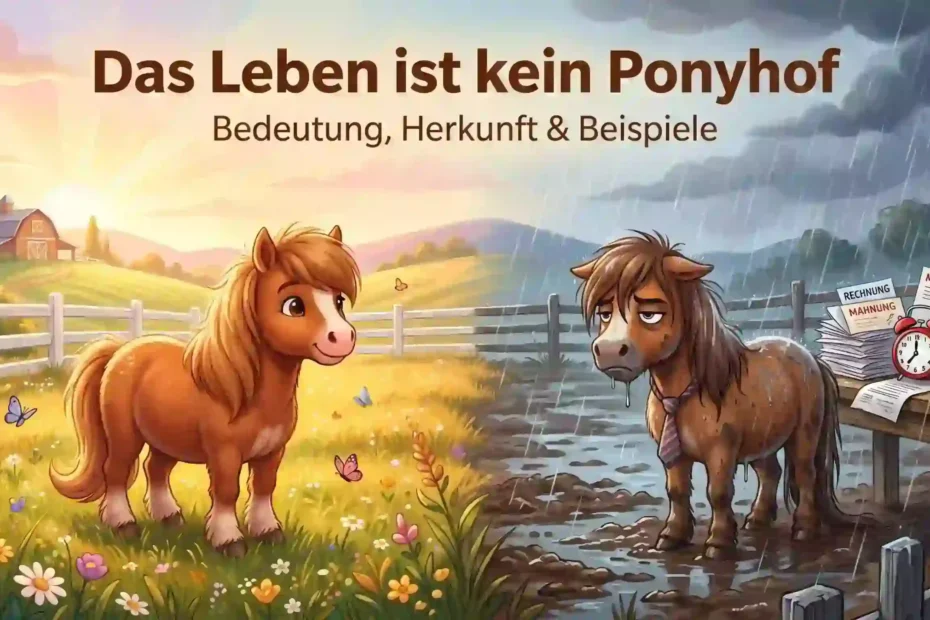
You hear a German friend sigh, “Tja, das Leben ist kein Ponyhof,” and everyone at the table nods except you. Was it a joke, a complaint or advice? Missing the point of a common idiom makes you feel like an outsider in your own conversation. This guide explains the Das Leben ist kein Ponyhof Bedeutung in plain words, with its origin, real examples, English equivalents and tips to use it like a native.
Quick answer: “Das Leben ist kein Ponyhof” literally means “Life is not a pony farm.” Germans say it to point out that life is not always easy, fun or fair, and that you have to face hard moments and keep going. The closest English match is “Life isn’t a bed of roses.”
What Does “Das Leben Ist Kein Ponyhof” Mean?
At its core, the saying is a reality check. It reminds the listener that life brings work, stress, setbacks and disappointment, not just sunshine and fun. People use it when someone complains about a normal hardship or expects things to come easily.
The Das Leben ist kein Ponyhof Bedeutung works on two levels. On the surface, it sounds a bit cold, like “Stop whining.” Underneath, it often carries a warm message: “Yes, this is hard, but hard is normal, and you can handle it.”
Think of it as the German version of a shrug and a pat on the shoulder at the same time. It accepts the problem, adds a touch of humor and pushes you forward. That mix of honesty and dry wit explains why the phrase feels so typically German.
Here is what the idiom expresses in one list:
- Life contains duties you do not enjoy
- Success usually takes effort and patience
- Disappointment is part of normal adult life
- Complaining alone will not change the situation
- You can still laugh about the struggle
A Word-by-Word Breakdown of the Phrase
Breaking the sentence into its parts makes it easy to remember. Each word is simple, and the magic sits in the final compound noun. Here is the literal structure:
- Das means “the” (neuter article, because “Leben” is a neuter noun)
- Leben means “life” and comes from the verb “leben,” to live
- ist means “is”
- kein means “no” or “not a” and negates a noun
- Ponyhof means “pony farm” or “pony stable,” built from “Pony” and “Hof” (farm, yard or court)
German loves compound nouns, and “Ponyhof” is a perfect example. The last part of the word decides its gender, so “der Hof” makes it “der Ponyhof.” The plural is “die Ponyhöfe,” with an umlaut on the o.
Anyone who searches for the Das Leben ist kein Ponyhof Bedeutung quickly notices that a literal translation sounds odd in English. Nobody in London or New York compares life to a pony farm. That gap between the literal words and the real meaning is exactly what makes idioms fun to learn.
Where Does the Saying Come From?
The first person to say it is unknown. Like most colloquial sayings, it grew in everyday speech long before anyone wrote it down. The phrase belongs to modern German and has no roots in old proverbs, the Bible or classic literature.
Older German already had a family of similar “life is not…” expressions. Speakers said life is no “Wunschkonzert” (request concert), no “Zuckerschlecken” (sugar licking) and no “Picknick” (picnic). Another older line went “Wir sind hier doch nicht im Mädchenpensionat,” meaning “This is not a girls’ boarding school.” The pony farm version fits neatly into this pattern.
The earliest widely cited recorded use is a 2001 album title by the German punk band Die Schröders. Soon after, the German office comedy “Stromberg” (2004 to 2012) helped push this style of blunt, sarcastic wisdom into living rooms across the country. Social media, memes, mugs and T-shirts then turned it into one of the most quoted lines in casual German.
So the story behind the Das Leben ist kein Ponyhof Bedeutung is not ancient. It reflects late 20th and early 21st century German culture, with its humor, directness and love of slightly absurd images.
Why a Pony Farm? The Picture Behind the Words
To feel the full punch of the phrase, you need to know what a “Ponyhof” means to Germans. For many children, especially girls, a summer week at a pony farm is pure paradise. They ride ponies, brush manes, sleep in bunk beds and spend whole days outdoors with friends.
German childhood culture is full of horse stories. Children’s series like “Bibi und Tina,” set on a riding farm, horse magazines and pony books shaped the image of the Ponyhof as a carefree, happy place. The word instantly calls up a picture of sunny meadows and zero responsibility.
The saying takes that childhood dream and holds it up against adult reality. Bills, deadlines, exams, illness and heartbreak do not exist on the imagined pony farm. The contrast is so extreme that it becomes funny, and the humor softens the hard truth.
Here is a detail that adds a hidden layer of irony. Anyone who has actually worked on a real pony farm knows the job means mucking out stables at six in the morning, hauling hay in the rain and cleaning hooves. Even the real Ponyhof is no Ponyhof, which makes the Das Leben ist kein Ponyhof Bedeutung even more fitting.
How Germans Use the Phrase in Everyday Life
You will hear the saying in homes, offices, locker rooms and group chats. The words stay the same, but the purpose changes with the situation. Here are the most common settings:
- Parents and teenagers: A teen complains about chores or homework, and a parent answers with the phrase as gentle tough love.
- The workplace: A colleague grumbles about overtime or a strict boss, and a coworker says it with a grin to show solidarity.
- Sports: A coach uses it after a painful loss to remind players that progress takes sweat.
- Friends: One friend shares bad news, and another responds with the phrase to say, “I get it, life is tough right now.”
- Self-talk: People mutter it to themselves before a hard task, almost like a motivational slogan.
Germans often add little filler words before the phrase. “Tja,” “Na ja” and “Tja, weißt du” all soften the delivery and make it sound more like a sigh than a lecture. A short phrase like “Tja, das Leben ist kein Ponyhof” can feel friendly and understanding.
In practice, the Das Leben ist kein Ponyhof Bedeutung depends heavily on who speaks and how. A smile turns it into shared humor. A stern face turns it into a reprimand.
Real Example Sentences with English Translations
Examples show you how the phrase fits into real conversation. Each sentence below uses the idiom in a natural way, followed by a clear English version. Read them out loud to build confidence.
- “Du musst morgen um sechs aufstehen? Tja, das Leben ist kein Ponyhof.”
You have to get up at six tomorrow? Well, life isn’t a bed of roses. - “Ich weiß, die Prüfung war schwer, aber das Leben ist nun mal kein Ponyhof.”
I know the exam was hard, but life just isn’t always easy. - “Der Chef will den Bericht bis Freitag. Das Leben ist kein Ponyhof.”
The boss wants the report by Friday. Nobody said it would be easy. - “Wir haben verloren, Jungs. Das Leben ist kein Ponyhof, also trainieren wir härter.”
We lost, guys. Life is tough, so we train harder. - “Hier ist kein Ponyhof! Jeder räumt sein eigenes Geschirr weg.”
This isn’t a holiday camp! Everyone clears away their own dishes. - “Mit 18 dachte ich, alles wird leicht. Heute weiß ich: Das Leben ist kein Ponyhof.”
At 18 I thought everything would be easy. Today I know life isn’t a walk in the park. - “Die Miete steigt schon wieder. Na ja, das Leben ist kein Ponyhof.”
The rent is going up again. Oh well, life is no picnic. - “Sie hat den Job nicht bekommen, aber sie weiß, dass das Leben kein Ponyhof ist.”
She did not get the job, but she knows life is not always fair.
Notice sentence 8. In a subordinate clause starting with “dass,” the verb “ist” moves to the end. This small grammar shift trips up many learners, so practice it a few times.
English Equivalents and Translations
No English idiom matches the German phrase word for word, but several carry the same message. The best choice depends on tone and region. If you want to explain the Das Leben ist kein Ponyhof Bedeutung to an English speaker, any of these will work:
- Life isn’t a bed of roses
- Life is no picnic
- Life isn’t a walk in the park
- Life isn’t all sunshine and rainbows
- Life isn’t a bowl of cherries
- Life is not all beer and skittles (British)
- Welcome to the real world
- Nobody said it would be easy
Other European languages have their own versions too. French speakers say “La vie n’est pas un long fleuve tranquille” (life is not a long, calm river). Spanish speakers say “La vida no es un camino de rosas,” and Italians say “La vita non è tutta rose e fiori.”
The table below compares the German saying with its closest relatives so you can pick the right phrase every time. It covers German variations, English equivalents and tone, which gives you a full view of the Das Leben ist kein Ponyhof Bedeutung in context.
| Expression | Language | Literal Translation | Real Meaning | Tone | Best Used When |
|---|---|---|---|---|---|
| Das Leben ist kein Ponyhof | German | Life is not a pony farm | Life is not always easy or fun | Humorous, direct | Someone complains about a normal hardship |
| Das Leben ist kein Wunschkonzert | German | Life is not a request concert | You can’t always get what you want | Matter-of-fact | Plans or wishes do not work out |
| Das ist kein Zuckerschlecken | German | That is no sugar licking | This task is hard work | Neutral | Describing a tough job or challenge |
| Das ist kein Kindergeburtstag | German | This is no kid’s birthday party | This is serious, so behave accordingly | Firm | Calling for focus and discipline |
| Hier ist kein Ponyhof | German | This is no pony farm | Rules apply here, no special treatment | Strict, bossy | A boss, teacher or parent sets limits |
| Life isn’t a bed of roses | English | Same | Life includes pain and difficulty | Gentle, classic | Comforting someone with honesty |
| Life is no picnic | English | Same | Life is demanding | Casual | Everyday chat about stress |
| Not all beer and skittles | British English | Life is not all beer and games | Life is not only pleasure | Old-fashioned, playful | Light, humorous moments |
| La vie n’est pas un long fleuve tranquille | French | Life is not a long calm river | Life brings ups and downs | Reflective | Talking about life changes |
| La vida no es un camino de rosas | Spanish | Life is not a path of roses | Life is not always pleasant | Gentle | Encouraging someone through trouble |
Similar German Idioms You Should Know
German has a rich collection of sayings about hard work and harsh reality. Learning them together helps you sound natural and pick the right shade of meaning. These are the ones you will hear most often:
- Das Leben ist kein Wunschkonzert: Life is not a request show. You do not always get what you order.
- Das ist kein Zuckerschlecken: It’s no sugar licking. The task is tough.
- Ohne Fleiß kein Preis: No diligence, no prize. Success needs effort.
- Von nichts kommt nichts: Nothing comes from nothing. You reap what you put in.
- Da muss man durch: You have to get through it. There is no shortcut.
- Wir sind hier nicht bei “Wünsch dir was”: We are not on a wish show. Your wishes are not orders.
- Es ist noch kein Meister vom Himmel gefallen: No master ever fell from the sky. Everyone starts as a beginner.
The pony farm phrase stands out because of its playful image. “Wunschkonzert” focuses on unfulfilled wishes, while “Zuckerschlecken” focuses on effort. “Ponyhof” covers the whole idea that life in general is not a carefree holiday.
Tone and Register: Friendly Reminder or Harsh Brush-Off?
The phrase belongs to informal, colloquial German. You will rarely find it in a formal letter, a legal text or a serious news report. It fits best in spoken conversation, texts, social posts and relaxed writing.
Tone matters more than the words themselves. Understanding the Das Leben ist kein Ponyhof Bedeutung means knowing when it comforts and when it stings. Here is a simple guide:
- Sounds kind: Said with a smile, a sigh or a shared laugh, often about your own problems
- Sounds neutral: Used as a general comment on a tough situation without blaming anyone
- Sounds harsh: Said with a stern face to someone who is grieving, sick or truly struggling
Use good judgment. Never say it to someone who just lost a loved one, received a serious diagnosis or faces a real crisis. In those moments, the phrase sounds dismissive and cold, and an honest “Das tut mir leid” (I’m sorry) works far better.
Common Mistakes Learners Make
Even advanced learners slip up with this idiom. Most errors involve grammar, word order or tone. Avoid these and you will sound much more fluent:
- Using “nicht ein” instead of “kein”: Germans say “kein Ponyhof,” never “nicht ein Ponyhof.”
- Dropping “kein” altogether: “Das Leben ist nicht Ponyhof” sounds broken.
- Wrong word order after “dass”: Write “dass das Leben kein Ponyhof ist,” with the verb at the end.
- Translating it literally for English speakers: “Life is not a pony farm” confuses people unless you explain it.
- Using it in formal writing: It feels too casual for business emails to clients or official documents.
- Wrong timing: Saying it during real grief or tragedy comes across as insensitive.
A learner who grasps the Das Leben ist kein Ponyhof Bedeutung but ignores these details still risks sounding awkward. Small fixes like “kein” and correct verb placement make a big difference.
How to Pronounce It Correctly
Good pronunciation makes the phrase sound natural instead of textbook. The sentence is short, so a few minutes of practice will do. Here is a simple English-friendly guide:
- Das: “dahs,” with a short a, like “dust” but more open
- Leben: “LAY-ben,” stress on the first syllable
- ist: “ist,” just like the end of “list”
- kein: “kine,” rhymes with “fine”
- Ponyhof: “PON-nee-hohf,” stress on “PON,” with a long o in “hof”
Put together, it sounds like “dahs LAY-ben ist kine PON-nee-hohf.” Germans often speak it quickly and slightly blend “ist kein” into one flowing sound. Listen to native speakers in films, podcasts or YouTube videos and copy their rhythm.
The Life Lesson Hidden Inside the Phrase
Behind the sarcasm sits a real piece of wisdom. The phrase teaches acceptance: hardship is a normal part of life, not a sign that something has gone terribly wrong. That simple shift in mindset can lower stress and help you act instead of freeze.
Many people suffer twice. First, the issue itself, and second, the conviction that it should not be there. The saying cuts out that second layer of pain by stating the obvious with a wink.
The Das Leben ist kein Ponyhof Bedeutung also connects to resilience. When you expect some bumps on the road, you recover faster from each one. You stop asking “Why me?” and start asking “What now?”
Here is how you can turn the idiom into a practical mindset:
- Expect challenges and plan for them
- Separate what you can control from what you cannot
- Allow yourself to feel frustrated, then move on
- Find small moments of joy even on hard days
- Laugh at the absurd parts of life whenever you can
The phrase does not say life is bad. It says life is real, and real life still holds plenty of good moments between the muddy ones.
The Phrase in Pop Culture, Merch and Social Media
Few German idioms have become as visible as this one. You can find it printed on coffee mugs, T-shirts, posters, greeting cards and stickers. Many designs show a cute pony looking grumpy or tired, which plays nicely with the joke.
On social media, the line works as a caption for relatable struggles. People post it with photos of Monday morning traffic, piles of laundry or rainy holiday weather. Memes often pair it with pictures of ponies in silly or dramatic poses.
Writers and comedians also love the phrase. It appears in book titles, blog posts, stand-up routines and song lyrics across the German-speaking world, including Germany, Austria and Switzerland. Its wide use shows how deeply the idiom has settled into everyday culture.
How to React If Someone Tells You That
Suppose a German friend or colleague uses the phrase in a conversation with you. A good reply proves you caught the Das Leben ist kein Ponyhof Bedeutung, both the joke and the message. Here are some natural responses:
- “Stimmt leider.” Sadly true.
- “Ja, aber ein bisschen Ponyhof wäre schon schön.” Yes, but a little pony farm would be nice.
- “Da hast du recht. Wir schaffen das.” You’re right. We’ll manage.
- “Ich weiß, ich weiß.” I know, I know.
- “Leider nicht, sonst wäre ich jetzt beim Reiten.” Sadly not, or I’d be out riding now.
Playful answers like the second and fifth options earn real smiles from native speakers. They show you understand both the language and the humor behind it.
If the phrase feels too harsh in the moment, you can also answer honestly. Saying “Ich weiß, aber gerade ist es wirklich schwer für mich” (I know, but right now it’s really hard for me) sets a clear boundary in a polite way.
Frequently Asked Questions
What is the Das Leben ist kein Ponyhof Bedeutung in simple English?
The Das Leben ist kein Ponyhof Bedeutung is “Life is not always easy or fun.” Literally, it says “Life is not a pony farm,” and it reminds people that hard work and setbacks are normal.
Is “Das Leben ist kein Ponyhof” rude?
It is not rude by itself. Said with a smile, it sounds friendly and humorous, but it can feel cold if you say it to someone facing grief or a serious crisis.
What is the English equivalent of “Das Leben ist kein Ponyhof”?
The closest English equivalents are “Life isn’t a bed of roses,” “Life is no picnic” and “Life isn’t a walk in the park.” All three share the same honest message.
Where does the phrase come from?
The exact origin is unknown, as with most colloquial sayings. It belongs to modern German, and a 2001 punk album by Die Schröders plus the TV comedy “Stromberg” helped spread it widely.
Can I use the phrase in formal writing?
No, it is better to avoid it. The idiom is colloquial, so it fits casual talk, texts and social posts, but not business letters, academic papers or official documents.
What is the difference between “kein Ponyhof” and “kein Wunschkonzert”?
“Kein Ponyhof” says life is not easy or carefree in general. “Kein Wunschkonzert” focuses on wishes and means you cannot always get what you want.
Ready to Use It Like a Native Speaker?
You now know the full Das Leben ist kein Ponyhof Bedeutung, far beyond the literal words. You understand the meaning, the pony farm image, the origin, the right tone and the grammar that makes the sentence work. That knowledge turns a confusing phrase into a tool you can use with confidence.
Here is your challenge for this week: use the idiom once in a real German conversation, text or social post. Pick a light, everyday moment, add a “Tja” in front and watch how naturally it lands. Then try one of the related idioms from the table above.
Life may not be a pony farm, but learning German can still be a lot of fun. Save this guide, share it with a friend who studies German and come back whenever you need a quick refresher.